We’re going to do something a little unusual here: give you an honest framework for choosing a music school — one you can use to evaluate us, and anyone else you’re considering.
We’ve been teaching music in Hamilton since 2019, and in Toronto for a decade before that. We’ve seen what makes a music school work and what makes families leave frustrated after a year. Here’s what actually matters.
1. Does the Teacher’s Personality Match Your Child — Not Just Their Resume?
This is the one most parents don’t think to ask, and it’s the most important factor by a wide margin.
A teacher with a music degree from a prestigious school can be completely wrong for your 7-year-old. A teacher with fewer credentials who genuinely connects with kids, remembers what your child told them last week, and makes them laugh while they’re learning? That teacher will change your child’s relationship with music.
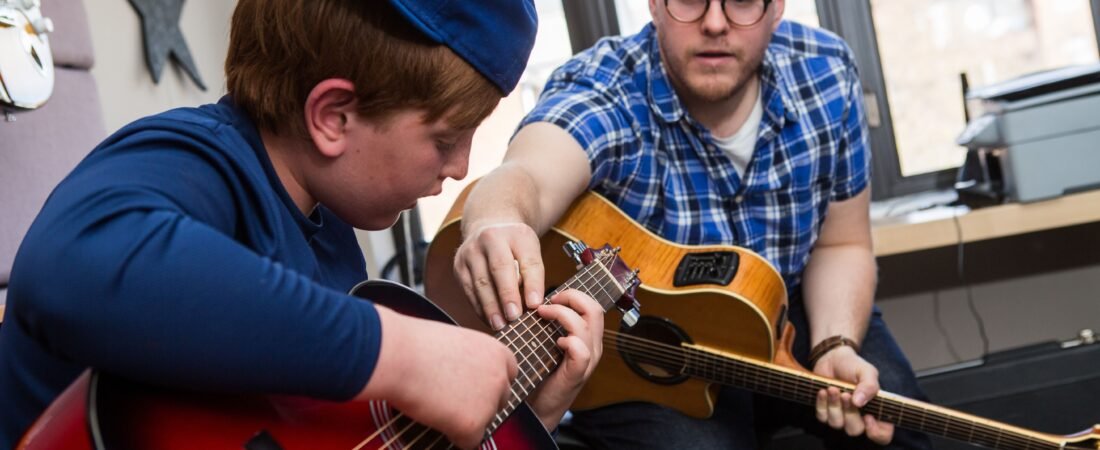
When you visit a school — and you should always visit before enrolling — watch how the teacher talks to your child. Do they get down to their level? Do they listen when the child says “I want to learn that song”? Or do they redirect immediately to the curriculum?
At Footprints, we hire for personality first. A teacher who loves what they do and genuinely likes kids is something you can’t train into someone. We’d rather have that than a wall full of certificates.
2. Does the School Actually Listen to What Your Child Wants to Play?
This sounds obvious. It isn’t.
A lot of music schools run students through a fixed curriculum regardless of what the student is interested in. The logic is defensible — foundations matter, theory matters, technique matters. But if a 10-year-old sits through six months of exercises without playing a single song they recognize or care about, you’re going to lose them.
We’ve built our approach around hearing what students want and weaving it into how they learn. A kid who wants to play video game music learns theory through video game music. A teenager who wants to play Metallica learns rhythm, timing, and dynamics through Metallica. The fundamentals are still there — they’re just wrapped in something the student actually cares about.
Ask any school you’re considering: what happens if my child wants to learn a specific song? The answer tells you everything.
3. Is Music Treated as a Grade — or as a Life Skill?
This is where schools differ most sharply in philosophy, and where you need to be honest with yourself about what you want for your child.
RCM exams and competitions have their place. They build discipline and provide external benchmarks. But they can also turn music into a source of anxiety and judgment — especially for kids who aren’t naturally competitive or who process pressure poorly.
We made a deliberate choice when we founded Footprints: no mandatory exams, no competitions, no grades. Our students still progress. They still have clear goals and weekly objectives. But progress is measured against the student — not against a standardized rubric that doesn’t account for how that particular kid learns.
The result? Students who stay. Not for a year, but for five or six years. Parents who tell us their child asks to practice. Kids who pick up an instrument at 30 because they loved what music felt like when they were young.
If you want RCM preparation, we can work with that — we’re not anti-exam. But it’s never our default, and we’ll never quietly pressure a student toward it.
4. What Happens When Your Child Misses a Lesson?
Life happens. Ask about the makeup policy before you sign anything.
Watch out for schools that charge full price for missed lessons with no makeup option, or that have so many blackout periods makeups become impossible to schedule.
Our policy is straightforward: cancel 24 hours in advance, get a makeup credit you can book through the parent portal. If your child is sick but well enough to sit at a screen, we offer Zoom lessons. Every missed class also includes a recorded video lesson from the teacher so progress doesn’t stall.
5. How Long Has the School Been Around?
Longevity in a service business is a data point. Schools that cut corners on teacher quality or student experience don’t tend to survive long. The ones doing something right stick around.
Footprints Music has been operating since 2009 — through a recession, a relocation, and a pandemic. We’re not mentioning that to pat ourselves on the back. We’re mentioning it because when you’re choosing someone to invest your child’s time and your family’s money with, track record matters.
The best thing you can do before deciding? Come in.
A free trial lesson tells you more than any checklist can. Watch how the teacher connects with your child. Notice whether the space feels welcoming. Trust your gut — it’s usually right.
We’d love to be one of the schools you consider.
Footprints Music offers piano, guitar, voice, drums, and ukulele lessons in Hamilton for kids, teens, and adults. Learn more about our approach →